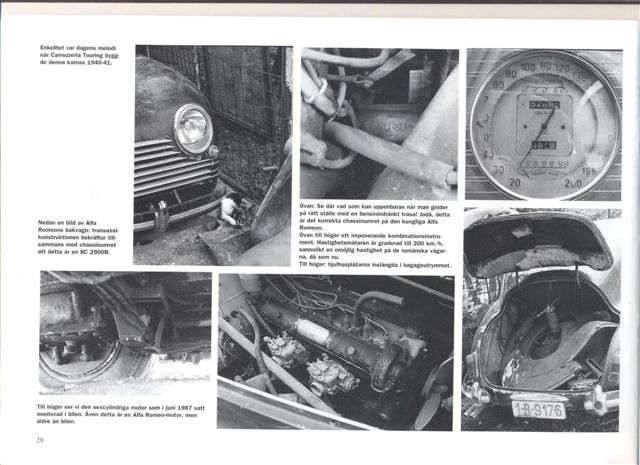
Venice Architecture Biennale 2010: visitors to the Romanian Pavilion in the Giardini di Castello at the Venice Architecture Biennale are invited to experience the population density of Bucharest, one at a time. A 94 square-meter box encloses most of the space inside the pavilion, with one visitor admitted to its interior at a time. Visitors queueing in the gap between the enclosure and pavilion walls can glimpse the enclosed space through three peep holes. The interior is illuminated by a large circular hole in its ceiling.Above: view from inside The installation was created by Romina Grillo, Ciprian Ra?oiu, Liviu Vasiu, Matei Vlasceanu and Tudor Vlasceanu. See all our stoires about Venice Architecture Biennale 2010 in our event category
The premise of the project entitled “1:1”, which will be exhibited in the Romanian Pavilion from Giardini di Castello, is a radical one: architecture as translation of a unique idea, ultimately determining and defining the space we inhabit. The concept is to “exhibit space” and, by doing so, to explore its various instances. A specific and quantifiable fact is related to the idea of “space”: 94m2/person is the population density level in Bucharest, and its representative for the urban condition in Romania. It illustrates, at the same time, both an individual and a collective state of existence. 94 m2 will be the exhibited “space”. It will be experienced by one person at a time. Translating at 1:1 scale this abstract and yet fundamental relationship between man and its space, becomes a key in decoding different meanings of space. The architecture is the physical presence of the enclosed exhibited space and by a seemingly violent process it defines two spaces, two worlds: one that is planed and another that is accidental and a consequence of the first. The exterior of the architectural object, a collective space, presents an enigma. Moving around it prepares the visitors and reveals fragments in three very precise moments thru small round openings in the walls. The interior of the architectural object, an individual space, has the desired 94 m2 surface. The space receives daylight through a circular opening in the ceiling which together with the three perforations acts as a system of reference for the person inside and defines the inner space with the minimum geometric means necessary. The rotated geometry de-materializes the architectural object, creating a relationship between an individual, interior, sacred, private, abstract space and a collective, exterior, profane, public, real space. The tension between these spaces keeps them united; one cannot exist without the other and both cannot exist without architecture.
Autor: omdecultură
-
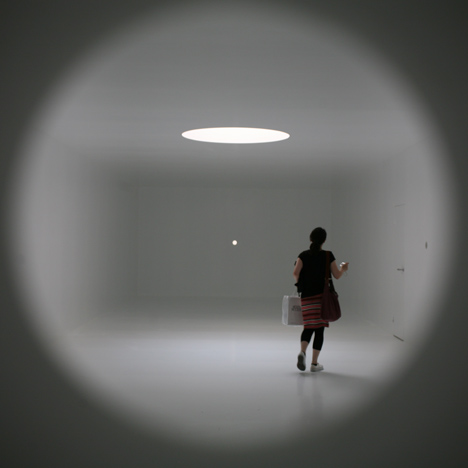
1:1 at the Romanian Pavilion
-
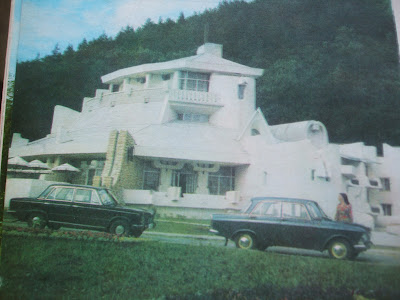
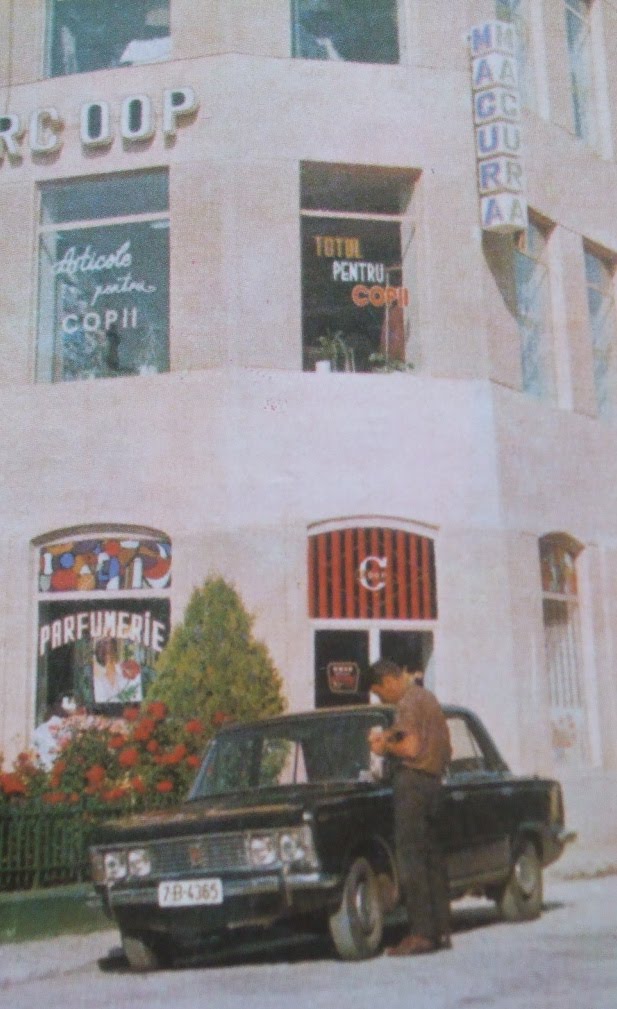
Fiat 125
Din seria "Masinile Comunismului", doua poze color din 1977 aratand Fiaturi 125. Masina, foarte populara pentru elita sociala anilor 70, a fost importata in 250 exemplare pentru vanzare pe piata libera, numar care nu include exemplare destinate institutiilor sau importate neoficial. Paralel, au sosit in tara 250 Fiaturi 124, un celebru proprietar fiind soferul de curse Alexe de Vassal, masina fiind si astazi in stare excelenta.


-
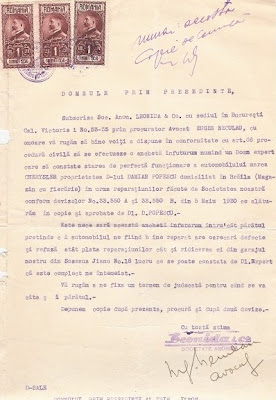
Document fiscalizat LEONIDA & Co
Arhiva AUTOMOBILIA s-a imbogatit astazi cu un document fiscalizat depus la Tribunalul Ilfov in anul 1930 de avocatul firmei auto LEONIDA & Co . Cladirile atelierelor LEONIDA & Co exista si astazi in Pta Victoriei (Bd. Aviatorilor). Firma solicita un expert care sa constate starea perfecta de functionare a automobilului reparat in atelierele LEONIDA & Co. Faptul ca automobilele ajungeau din Braila in capitala pentru reparatii prezinta indirect inexistenta unor ateliere auto in zona respectiva. Documentul este foarte valoros din punct de vedere colectionistic pentru stampila firmei LEONIDA & Co.

-
Welham Studio by Mark Merer
British designer Mark Merer has created a studio for himself and his wife near the small town of Somerton in Somerset, England..
-
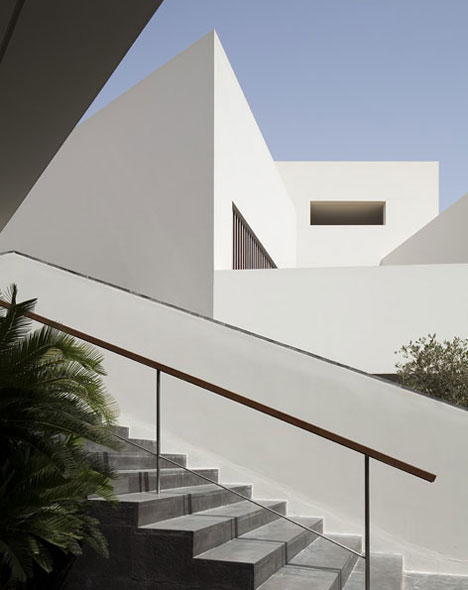
Star House by AGi Architects
Photographer Nelson Garrido has sent us some images of a house designed by AGi Architects located next to a beach in Bnaider, Kuwait. Called Star House, the side of the house facing the beach has floor to ceiling windows, affording panoramic views of the sea. The design was initially for three detached houses, but the client decided on a single residence with two bungalows and a boathouse. Photographs are courtesy of Nelson Garrido. See more photography by Nelson Garrido » See all our photography stories » The following information is from the architects:
Project Description Nestled into the landscape, this beach house blends with the natural topography of the coastline of Kuwait.It slowly unfolds itself to the visitor, as it is approached from the desert. Upon entry, one gets glimpses of the sea whilst going down to the public space of the chalet.On this lower level, the house extends into the landscape and the sea, accentuated by an infinity pool in the garden. The private side of the house, located at the entry level, is concealed from the visitors by a bamboo wall. Bedrooms and private living spaces remain isolated from daily activities. A three-way stair, placed at the center of building, organizes the different flows of family, friends and guests. The organizational and formal structure of the beach house is dictated by the ability to maximize views to the sea. The initial design was master planned for three detached dwellings, each with extensive sea views while simultaneously achieving privacy from one another. The client, instead, opted for a single house, two bungalows and a boathouse, with possible plans for expansion in the future.Click for larger image Project Name:Star House
Type:Housing | 5000 sqm
Location:Bnaider, Kuwait
Date:2007/2009
Client:Private Design Team: Dr. Nasser B. Abulhasan, Joaquin Perez-Goicoechea, Georg Thesing, Bruno Martins, Alfonso Gomes, Daniel Muñoz Medranda,
Robert A. Varghese, Abdul Hafiz Mohammed, Moyra Montoya Moyano Company Profile AGiarchitects is an international designfirmprovidingcomprehensive services inArchitecture, Planning,UrbanDesign, InteriorDesign, Design Research and Consulting. An integration of skills allows the creation of places that provide lasting value for clients through distinctive and imaginative solutions. AGi architects was established in 2005 by Joaquin Perez-Goicoechea and Nasser B. Abulhasan.Click for larger image AGi architectshas introducedexceptional design, management and technicalapproaches to its projects in the Europe and theMiddleEastfromits officesin the cities of MadridandKuwait.With a multidisciplinary staff of over 30 professionals includingarchitects, planners,landscapearchitects,interiordesignersandother specialists, individual members of the design team can be carefully selected to reflect the necessary skills for the scope and scale of the project. Great emphasis is placed oncontinuitysothatworkis client driven rather than project centered. Clients work with architects they know and over time, the team is able to develop a thorough understanding of the clients’ business objectives and priorities and is able to make more effective contributions to their projects -
Hospices de Beaune : «La qualité est là, pas la quantité»
Comme tous les ans, le troisième dimanche de novembre, a lieu en début d’après-midi la célèbre vente de charité des vins de Bourgogne des Hospices de Beaune, dans les anciennes halles de la ville.
C’est dimanche, à 14h30, que débutera sous le marteau de la maison Christie’s et la co-présidence de Fabrice Luchini et de l’acteur chinois Liu Ye, la célèbre vente aux enchères des vins de Bourgogne.
Malgré la pluie fine en toile de fond à Beaune, tous les ingrédients sont réunis pour que la 150ème édition des enchères des Hospices soit un bon cru. «La qualité est là mais pas la quantité. Il y a 150 pièces de moins à la vente par rapport au 799 de l’an dernier», explique Alberic Bichot, co-gérant de la maison plus que centenaire éponyme. Pour rappel, un fût ou pièce contient 228 litres de vin soit l’équivalent de 288 bouteilles. «Nous notons en outre un regain d’intérêt international avec 15 nationalités cette année, dont l’arrivée du Vietnam et la confirmation du retour du Brésil et de la Russie après la crise», poursuit de son côté Benoît de Charrette, co-gérant lui aussi chez Bichot, la maison locale qui depuis une décennie achète le plus de pièces le jour de la vente de charité.
«C’est la deuxième fois que je viens à Beaune pour acheter du bourgogne avec mes clients, des restaurateurs de luxe à Saint-Petersbourg», indique Dimitri dans un français impeccable, appris à l’époque de l’Union Soviétique où cette ville s’appelait encore Leningrad. «Les Russes aiment le vin italien mais nous voulons leur faire gouter les vins français et notamment le bourgogne», ajoute, dans la langue de Shakespeare, Yevgueni, un jeune restaurateur venu avec Dimitri. Mais il n’y a pas d’obligation d’achat. «C’est la première fois que je viens dans la capitale des bourgognes. Je ne compte pas acheter demain mais regarder comment cela se passe et revenir l’an prochain», indique pour sa part Bernardo, propriétaire d’une chaine de 10 supermarchés de luxe à Sao Paolo. Parmi les acheteurs professionnels, on note aussi des restaurateurs ou négociants du coin.
Possibilité d’acheter sur Internet
Cette vente est aussi ouverte à des particuliers riches comme John, un expert comptable anglais qui n’hésitera pas à mettre au moins 50.000 euros pour acheter un fût de Bâtard-Montrachet. «Je suis un passionné des vins français et je suis prêt à mettre ce prix pour la qualité et la part de rêve que cela représente», explique-t-il. Toutefois pour les budgets plus modestes, il est possible pour la seconde année consécutive d’acheter une partie d’un fut en passant un ordre sur internet, y compris le jour de la vente et même après. «Compte tenu du succès rencontré cette année avec plus d’une centaine de souscripteurs, nous allons laisser ouverte la vente sur le net au-delà de dimanche», explique Jean-David Camus, directeur marketing chez Bichot. «La vente sur la toile est possible à partir de six bouteilles. Cela revient à l’internaute, si l’enchère par exemple de la pièce est de 2600 euros, à moins de 25 euros TTC par bouteille et pour la bonne cause», explique-t-il.
«Les sommes récoltées iront alimenter une partie non négligeable, environ 5%, du budget de l’hôpital de Beaune», fait-il remarquer. Seule obligation pour tous les acheteurs, «l’élevage et la mise en bouteilles doit se faire en Bourgogne», précise Roland Masse, régisseur du domaine. Avec un peu de patience : l’acheteur devra attendre 15 mois pour cette opération avant sa livraison. Reste à savoir si dimanche soir le record du montant récolté l’an dernier, c’est-à-dire 5,45 millions d’euros, sera battu.
-
Books of the Year for Christmas
Pictures, whether brushed on to canvas or captured via a tiny blip of light, should offer a way of seeing that insists we sit up, take note and come in for a closer look. Taryn Simon’s Contraband (Steidl, £40) holds a mirror up to our appetites and misdemeanours, via the stray, illegal and counterfeit objects that pass through JFK airport in a single week. A catalogue of deer tongues, cow urine, Botox, a bird’s nest, Cohiba cigars and toy AK-47s, it forms a picture that is playful and absurd.
Neverland Lost (Steidl, £30) brings together a different kind of relic: objects that once belonged to Michael Jackson and were removed from Neverland ranch after his death. Henry Leutwyler’s unemotional portraits of worn shoes, gilt thrones and rhinestone hats are almost unbearably intimate, yet reassuring in their lack of sensationalism.
Similarly off-kilter is Edmund Clark’s Guantánamo (Dewi Lewis, £35), which approaches this political millstone not only via images of the camp complex but, more poignantly, through the homes in which the released detainees must rebuild their lives. Trained on spaces rather than the people who inhabit them, Clark’s lens is impartial, and hints at darker seams beneath.
Peter Galassi’s Henri Cartier-Bresson: the Modern Century (Thames & Hudson, £55) is a huge and beguiling foray into the life of an inveterate adventurer. This year also saw the first retrospective of André Kertész (Yale, £48) and a collection of the little-known work of Peter Sekaer (Signs of Life, Steidl, £43). This contemporary of Walker Evans – they often travelled together in their mission to document the Depression – produced photographs that are more spontaneous than Evans’s, and brim with little miracles engendered from dust and hunger.
Paris Between the Wars (Thames & Hudson, £28) is a visual survey of the years the French called les annees folles. Its selection of photographs, posters, illustrations, fashion and furniture vibrates at a beautiful pitch.
Across the pond, there were portraits of another city in New York in Postcards (Scheidegger & Spiess, £45), which traced the evolution of the city’s architecture and pastimes through the bombast of postcard artists. Stieglitz, Steichen, Strand (Yale, £25) offered a rare chance to see the three photographers who broke new ground for early practitioners, and in DC Comics (Taschen, £135) the superheroes swooped the famous skyline in formidably pulpy and shamelessly thrilling form.
A final mention to a small book titled Houdini (Yale, £25), which is a delightful discovery, stuffed with photographs and ephemera, including covers from Conjurers’ Monthly dating from 1905, and diary pages filled with his inky script.
As well as an enlightening peek into his peculiar talent, the authors consider the myth the man became, and its recent entry to the cultural lexicon as fodder to be mined by artists of today.
-
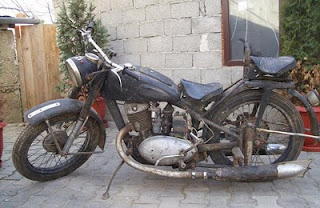
Bunatati de la bunica
Bunica Rusie si-a mai scos o odrasla la lumina din beciurile uitate de timp ale varstnicilor si a trimis-o in posesia lui Geani, prietenul bun la toate care s-a (re)molipsit de vechituri si si-a luat, citez din declaratia proprie "jucarie la batranete, sa aiba cu ce sa isi ocupe timpul". Odrasla este un IJ49 care se afla la un batranel in Ghimbav si care nu a mai folosit motocicleta de aproximativ 15 ani, pana astazi, cand a fost repornita de noul proprietar. Desi nu a fost pastrata in cele mai bune conditii, motocicleta arata potential destul de bun pentru restaurare, are in mare parte piesele originale, cu exceptia stopului de IMS si a farului modificat, dar prezinta si plusuri, mai ales in ceea ce priveste filtrul de aer si regulatorul-cutiuta electrica, piese care lipsesc de obicei in cazul acestor motociclete.

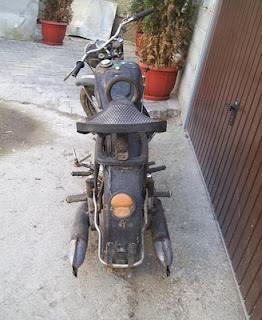
 In speranta revederii cat mai rapide pe sosele cu Ij-ul restaurat, va invit sa "TINETI APROAPE", sper ca în 3-4 zile sa va prezint un nou produs finalizat al colectiei motocicletedeepoca.ro .
 -
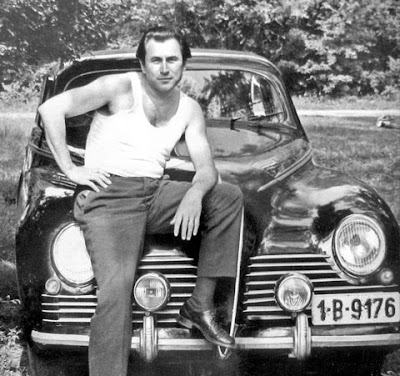
Alfa-Romeo 8C 2900 Touring, 1942
Una din cele mai interesante masini care a existat in Romania…
Se pare ca masina a fost comandata in 1942 de Casa Regala; conform cartea "The Immortal 2.9", scrisa de Simon Moore, a apartinut regelui Mihai. Caroseria coupe a fost facuta de carosierul italian Touring. Prima poza e in fabrica, inainte de livrare.
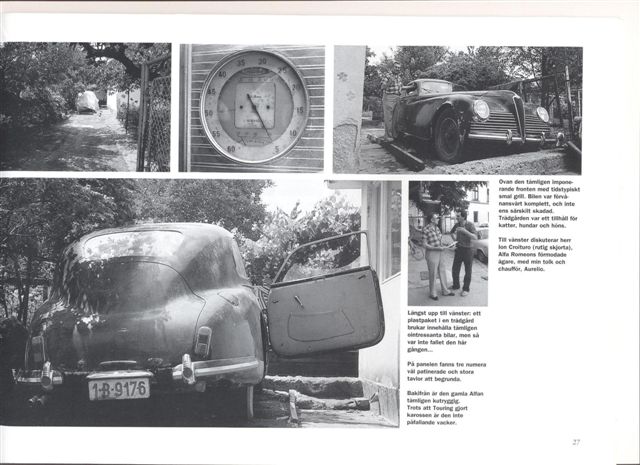
A trecut razboiul si au venit comunistii la putere, dar masina a ramas in tara. In 1966 un mecanic bucurestean, Ion Croitoru, a cumparat masina si impreuna cu fiul lui a restaurat-o (destul de rudimentar). Cativa ani buni, masina, inatriculata cu numarul 1-B-9176, a circulat pe strazile capitalei. Din pacate motorul original s-a pierdut, dar in loc sa puna ceva de ARO, Volga sau tractor, cum se obisnuia atunci, s-a gasit un motor Alfa de 2300 de pe un 6C – un fapt pentru care dl. Croitoru trebuie felicitat. Poza 2 il arata in 1968 la iarba verde.
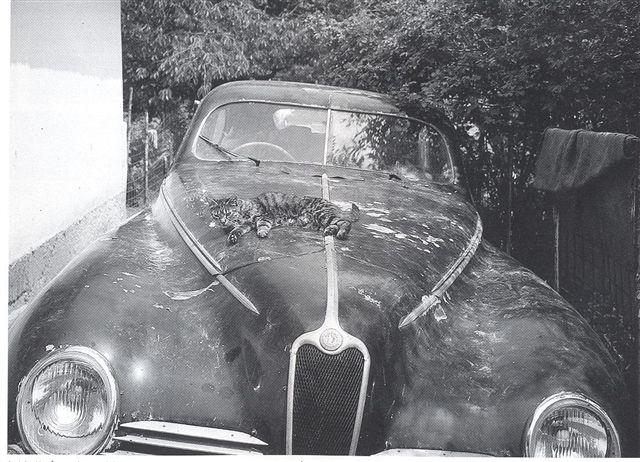
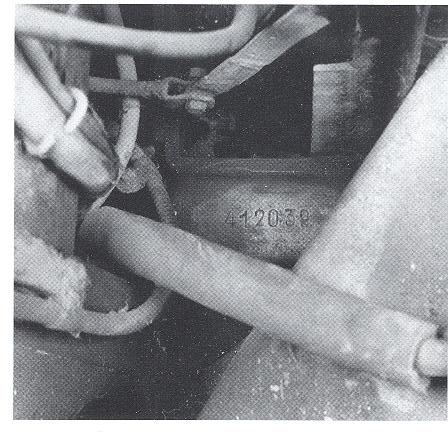
In 1987, un jurnalist suedez, Peter Haventon, a sosit in Bucuresti cautand doua masini: Duesenbergul de la Muzeul Tehnic si Alfa regelui. Cu ajutorul unui taximetrist, eventual l-a gasit pe Ion Croitoru cu tot cu masina. Masina nu era in stare foarte buna, totusi inca era cat de cat solida si cel putin tinuse cateva repere originale. Se vedea ca dusese o viata grea. Nu mai era folosita … devenise loc d dormit pentru pisicile din cartier. Totusi, liniile superbe inca se pot vedea.
Pozele 3,4,5 si 6 arata masina "dans son jus".Aici povestea ddevine complicata. La sfarsitul anilor 80, regretatul colectionar Terry Cohn a sosit in Romania. Si el cauta doua masini: Alfa, si un rarisim Mercedes-Benz W154 de curse (din care au existat doua in tara, primul exemplar fiind exportat in anii 70). Din ce se stie a reusit sa le scoata din tara, dar a fost o problema: securistii intermediari au vandut masinile altcuiva simultan, asa ca in Elvetia Cohn a trebuit sa se judece pentru drepturile la masini (e posibil ca celalalt cumparator sa fie Gavin Ruotolo). MB-ul nu l-a primit, iar tot ce se stie de Alfa e ca a sosit in Germania si a fost recarosata cu caroserie spider. Pacat! Din pacate nu am poze cu masina in prezent, banuiesc ca sunt in cartea lui Moore dar la cei 300 USD cat costa nu cred ca o sa aflu foarte curand…


-
Philippe Jaroussky, la voix du ciel
« Avec Caldara, je voulais montrer que, contrairement aux idées reçues, sa musique viennoise n’était pas composée pour répondre aux goûts de l’empereur, affirme Philippe Jaroussky.
À 32 ans, le contre-ténor est une star en France comme à l’étranger. Son nouvel album dédié à Caldara caracole déjà en tête des ventes.

Depuis trois ans, ses disques se vendent comme des petits pains. Son tout nouveau ne déroge pas à la règle: avec 1700 exemplaires écoulés en France dès la première semaine, il est déjà numéro un des charts, devant le CD de Cecilia Bartoli sorti trois semaines plus tôt. Rien, chez ce tranquille jeune homme à la voix d’or, ne traduit pourtant la «starification» dont il fait l’objet depuis plusieurs années. Philippe Jaroussky n’a de mots que pour la musique. Une musique à laquelle il n’hésite pas à consacrer aujourd’hui des mois entiers de recherche. Il est intarissable sur Antonio Caldara, compositeur prolixe mais méconnu de la fin du XVIIe siècle, chez qui il a puisé les treize titres inédits de son album Caldara in Vienna (Virgin). «J’ai parcouru quarante manuscrits de ses opéras avant de trouver les airs que je souhaitais, explique-t-il. Au départ, je ne pensais pas lui consacrer tout un album. Je suis juste allé voir chez lui par curiosité, car je voulais faire un disque autour du poète Métastase dont il avait été l’un des tout premiers à mettre les mots en musique.»
Cette quête d’inédits a de plus en plus la cote chez les chanteurs classiques. «C’est pour nous l’occasion de nous concentrer sur la musique elle-même, sans avoir à subir le poids des interprétations de référence», avoue humblement Jaroussky. L’occasion, surtout, de maîtriser un programme dans sa conception de A à Z. La force de ces chanteurs, stars des temps modernes dont il fait aujourd’hui partie, c’est d’avoir su transcender l’interprétation pour faire valoir une personnalité artistique complète, aussi compétente en matière de technique vocale qu’érudite en matière d’histoire de la musique. «Avec Caldara je voulais montrer que, contrairement aux idées reçues, sa musique viennoise n’était pas composée pour répondre aux goûts de l’empereur, argue-t-il en fin connaisseur. Les airs pour castrats que je chante ont tous été écrits lorsqu’il officiait à Vienne et montrent combien son langage subtil fuyait la séduction immédiate de la virtuosité en vogue à l’époque.»
Direction d’orchestre et création contemporaine
Les débats musicologiques, Philippe Jaroussky y est habitué. Lui qui découvrit la voix de contre-ténor en chantant par-dessus les disques de la Callas a dû affronter les foudres des nombreux mélomanes qui jugent encore que les voix de mezzo-soprano sont les plus à même de rendre la puissance des grands castrats d’autrefois. «Je ne pense pas que les rôles de castrats ne doivent échoir qu’à des hommes, je trouve simplement que mezzos et contre-ténors se complètent : la particularité des castrats, ce n’était pas tant leur virtuosité dans l’aigu que ce mélange de force et de fragilité qu’on trouvait dans leurs voix. De toute façon, on est loin d’en avoir fini avec eux, alors je me garderais bien de trancher le débat.»
Il a pour l’instant bien d’autres projets. Comme la direction d’orchestre, qu’il pratique à la tête de son ensemble Artaserse (avec lequel on le retrouvera le 11 décembre au Théâtre des Champs-Élysées pour un duo avec Andreas Scholl). Sans oublier la création contemporaine: en 2012, il participera à la création à Paris de l’opéra de Suzanne Giraud autour du Caravage. Et aussi des projets transversaux frayant avec le jazz ou la comédie musicale, histoire de rappeler que l’on peut être contre-ténor, spécialiste du baroque, et ne pas se prendre systématiquement au sérieux.